How to Make Money With Amazon KDP in 2026: Beginner’s Guide
Amazon Kindle Direct Publishing (KDP) lets anyone publish and sell books without going through a traditional publishing company. There’s no agent to convince, no manuscript to shop around for months, and no warehouse of unsold copies sitting in your garage. You upload your book, set your price, and it appears on Amazon alongside titles from major publishers.
But here’s the honest truth beginners need to hear before they get started: uploading a book is not the same as building an income. Success on KDP depends on a combination of factors working together — a clear book idea, a real audience for it, genuine quality, a cover that stands out, a description that sells, keywords that help people find you, sensible pricing, ongoing marketing, and consistency over time. Miss most of these, and even a well-written book can sit unsold on page ten of a search result.
This guide walks you through the entire KDP journey — from idea to research, creation, formatting, cover design, publishing, marketing, and scaling — so you understand what actually goes into building a publishing business in 2026. It won’t promise you passive income while you sleep or thousands of dollars overnight. What it will give you is a realistic, practical roadmap you can actually follow.
Can You Really Make Money With Amazon KDP?
Yes — authors can and do earn royalties from eligible KDP sales. But the honest answer has more nuance than a simple yes.
Income on KDP varies enormously from author to author and book to book. Some books sell consistently for years; others sell a handful of copies and then go quiet. A single title rarely changes anyone’s financial life, but a catalog of well-researched, well-produced books can create a meaningful secondary income stream over time.
The basic business model works like this: you (the author) create a book, KDP handles distribution, printing (for physical formats), and payment processing, and Amazon’s customers buy your book. You earn a royalty on each eligible sale, and Amazon keeps the rest to cover its costs and margin. There’s no upfront inventory to buy for print books, since KDP paperbacks and hardcovers are printed on demand only after a customer orders one.
What determines whether that model produces real income for you? Mostly the same variables that determine success in any content business: how well you understand your audience, how much genuine value your book delivers, how discoverable it is on Amazon’s search results, and how consistently you show up to market it. KDP is a platform, not a guarantee.
What Is Amazon KDP?
Kindle Direct Publishing is Amazon’s self-publishing platform. It allows independent authors and creators to publish three main formats — ebooks, paperbacks, and hardcovers — directly to the Amazon marketplace, without needing a literary agent or a publishing deal.
A few concepts are worth understanding from the start:
- Self-publishing means you are the publisher. You control your manuscript, cover, pricing, and metadata.
- Print-on-demand (POD) means your paperback or hardcover is only printed after a customer places an order. You don’t pay for printing upfront, and you don’t hold inventory. This single feature is what makes KDP accessible to beginners — there’s no financial risk of unsold stock piling up.
- Author control means you can update your manuscript, cover, price, and keywords at almost any time.
- Royalties are the share of each sale you receive, which depends on format, list price, and marketplace.
- Book ownership stays with you. You retain your rights and can also distribute the same content elsewhere, depending on the options you choose (more on that in the KDP Select section).
How Does Amazon KDP Make Money?
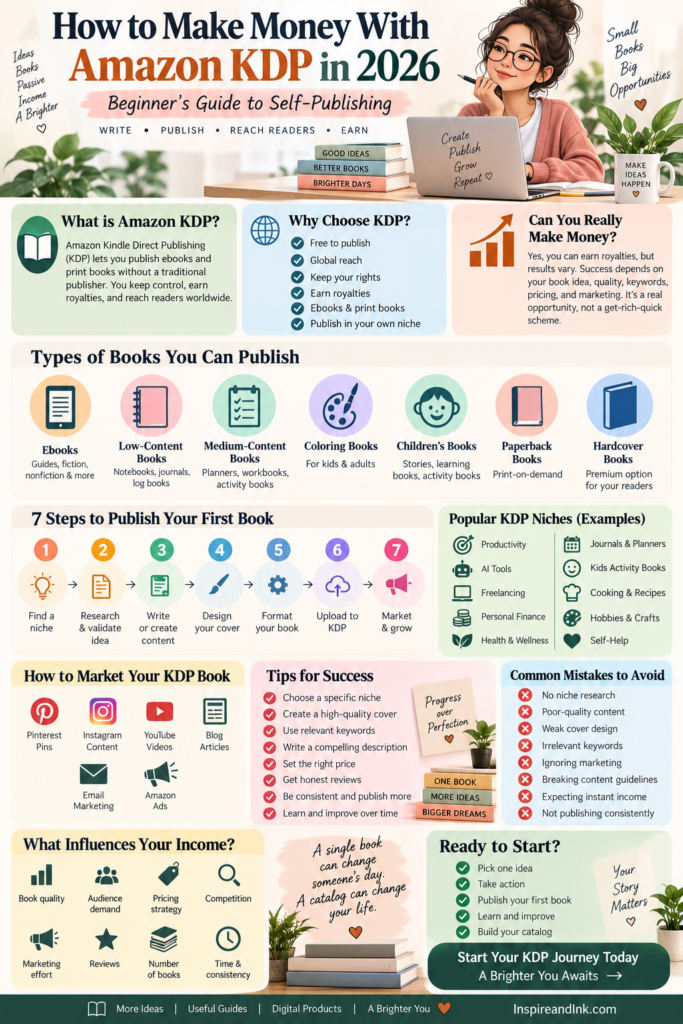
The basic flow looks like this:
Author → Amazon KDP → Customer → Sale → Royalty
You upload your book and set a list price. When a customer buys it, Amazon handles the transaction, delivers the ebook or ships the printed copy, and pays you a royalty based on the format and price. Amazon’s cut covers its distribution infrastructure, payment processing, hosting, printing (for physical books), and its own margin.
The exact royalty split and applicable costs depend on your chosen format, list price, and marketplace — these details are covered in the royalties section below. Because Amazon periodically updates its royalty structure, fee schedules, and price bands, it’s worth checking KDP’s official pricing and royalty pages before you finalize a price.
What Types of Books Can You Publish on Amazon KDP?
KDP supports a wide range of book types, and not all of them require the same skill set — or offer the same opportunity.
1. Ebooks
This is the most flexible category. Ebooks can be how-to guides, fiction, nonfiction, educational content, business books, or self-help. They require writing and editing skills but no printing logistics, and they’re usually the fastest format to launch.
2. Low-Content Books
These include notebooks, journals, log books, and simple planners — books with minimal or no written content, often just repeated page layouts (like lined pages or trackers). They’re relatively quick to produce, but competition is intense, and differentiation is hard because so many low-content books look similar. Standing out usually requires strong niche targeting and design, not just uploading a generic template.
3. Medium-Content Books
Guided journals, workbooks, activity books, and structured planners fall here. They combine some original written content (prompts, instructions, exercises) with structured layouts. This category tends to have a bit more defensibility than pure low-content books because the content itself adds value beyond the format.
If this guide helped you think through your own AI toolkit, explore more freelance and AI resources on Inspire and Ink —My ebook “How to Make Money With AI” shows you practical ways to use AI tools to create, promote, and sell digital products and build additional online income streams.
Whether you’re a freelancer, blogger, creator, or complete beginner, the ebook can help you discover ideas you can start exploring with the tools you already have.
👉 [Get “How to Make Money With AI” and start building your digital-income strategy]4. Coloring Books
Coloring books for adults and children remain popular, but the niche is crowded. Success usually comes down to distinctive illustration style, a clear theme, and matching a specific audience (stress relief, a hobby, a holiday, a skill level) rather than generic designs.
5. Children’s Books
Children’s books require careful attention to age-appropriate language, illustration quality, page layout, and content sensitivity. This is a category where quality genuinely matters — parents are discerning buyers, and reviews reflect that quickly.
6. Paperback Books
Paperbacks use Amazon’s print-on-demand model: no upfront printing costs, and copies are produced only when ordered. This makes paperbacks accessible to beginners, though formatting requirements (trim size, margins, bleed) are stricter than for ebooks.
7. Hardcover Books
Hardcovers are also print-on-demand through KDP and can add a premium option for readers, particularly for children’s books, journals, or gift-oriented titles. They typically carry higher printing costs and list prices than paperbacks.
Not every category offers equal opportunity. Low-content and coloring books are easier to start but harder to differentiate; ebooks and well-researched nonfiction often reward expertise and marketing more directly.
7 Ways to Make Money With Amazon KDP
1. Writing ebooks Best for: writers and subject-matter experts. Skills needed: writing, basic editing, niche research. Difficulty: moderate. Main advantage: fastest format to launch and update. Main challenge: standing out in a crowded ebook marketplace.
2. Publishing practical nonfiction guides Best for: professionals, freelancers, and hobbyists with real expertise. Skills needed: subject knowledge, clear explanation, structure. Difficulty: moderate. Main advantage: nonfiction readers often actively search for solutions, which helps discoverability. Main challenge: requires genuine expertise or thorough research to be credible.
3. Creating workbooks Best for: educators, coaches, and content creators. Skills needed: instructional design, basic layout skills. Difficulty: moderate. Main advantage: workbooks can serve evergreen educational niches (language learning, test prep, skill-building). Main challenge: interior formatting takes more care than plain text books.
4. Creating journals and planners Best for: designers and Canva users. Skills needed: layout design, niche targeting. Difficulty: beginner to moderate. Main advantage: relatively fast to produce once you have a template system. Main challenge: heavy competition and thin differentiation between similar products.
5. Publishing coloring or activity books Best for: illustrators and designers. Skills needed: illustration or curation, thematic consistency. Difficulty: moderate. Main advantage: appeals to gift-buyers and hobbyists. Main challenge: saturated categories and reliance on distinctive visual style.
6. Building a niche book series Best for: authors willing to commit to a long-term project. Skills needed: consistency, series planning, niche focus. Difficulty: moderate to high. Main advantage: series create repeat readers and cross-promotion opportunities. Main challenge: requires sustained output and quality across multiple books.
7. Turning existing content into books Best for: bloggers, freelancers, and content creators who already have material. Skills needed: content reorganization, editing for book format. Difficulty: beginner to moderate. Main advantage: you’re not starting from zero — you already understand what your audience wants. Main challenge: content needs to be substantially reworked, not simply copy-pasted, to work as a standalone book.
How to Find a Good KDP Niche
The single biggest mistake beginners make is starting with “I want to write this” instead of “there is a specific audience actively looking for this.” Those are very different starting points, and only one of them tends to lead to sales.
When evaluating a potential niche, look at:
- Audience demand — are people actually searching for and buying books like this?
- Competition — how many similar books exist, and how good are they?
- Search intent — what problem is the reader trying to solve when they search?
- Existing books — what do the top-selling titles in this niche do well or poorly?
- Reviews — what do readers complain about in competing books? That’s often your opportunity.
- Book quality — can you realistically match or exceed what’s already out there?
- Customer problems — is there an unmet need or an underserved angle?
- Evergreen potential — will demand for this topic exist next year, or is it a passing trend?
- Seasonal demand — does interest spike around specific times of year (e.g., New Year planners, holiday-themed journals)?
- Series potential — could this idea expand into multiple related books?
A niche isn’t good just because you find it personally interesting. It’s good when real demand and manageable competition intersect with something you can genuinely deliver well.
KDP Niche Examples
| Niche | Example Book | Audience | Competition Level | Series Potential |
|---|---|---|---|---|
| Freelancing | Guide to pricing freelance services | New freelancers | Moderate | High |
| AI tools | Beginner’s guide to AI writing tools | Content creators, small business owners | Moderate-High | High |
| Budgeting | 90-day budgeting workbook | Young professionals | High | Moderate |
| Productivity | Time-blocking planner | Remote workers | High | High |
| Gardening | Beginner vegetable garden journal | Home gardeners | Moderate | Moderate |
| Cooking | Weekly meal-prep planner | Busy families | High | Moderate |
| Hobbies | Knitting project log book | Craft hobbyists | Low-Moderate | Moderate |
| Journaling | Guided gratitude journal | Wellness-focused readers | High | High |
| Fitness planning | 12-week workout tracker | Home fitness enthusiasts | High | Moderate |
| Small business | Startup planning workbook | Aspiring entrepreneurs | Moderate | Moderate |
| Career development | Job search organizer | Job seekers | Moderate | Low |
| Children’s activities | Preschool activity workbook | Parents of toddlers | High | High |
No niche on this list — or anywhere else — is guaranteed to be profitable. Treat this table as a starting point for research, not a promise.
25 Amazon KDP Book Ideas for Beginners
- Freelance pricing guide — helps new freelancers set rates without underselling themselves.
- AI tools for small business owners — practical overview for non-technical entrepreneurs.
- 90-day budgeting workbook — structured exercises for people building better money habits.
- Weekly meal-prep planner — for busy professionals who want to eat healthier without daily decisions.
- Beginner gardening journal — tracks planting dates, growth, and seasonal notes.
- Remote work productivity guide — time management for people working from home.
- Gratitude journal with prompts — daily structured reflection for wellness-focused readers.
- 12-week home workout tracker — for people exercising without a gym membership.
- Startup planning workbook — step-by-step exercises for aspiring small business owners.
- Job search organizer — tracks applications, interviews, and follow-ups.
- Preschool activity workbook — early learning exercises for parents of young children.
- Habit tracker journal — for readers building consistency in daily routines.
- Freelance writing niche guide — for people exploring writing as a side income.
- Digital marketing basics for beginners — introductory guide for small business owners.
- Canva design workbook for creators — practical exercises for learning design fundamentals.
- Self-publishing checklist journal — for aspiring authors tracking their own publishing process.
- Minimalist living guide — for readers interested in decluttering and simplifying.
- Beginner’s guide to investing basics — general financial literacy content (non-advisory).
- Travel planning journal — for organizing trips, packing lists, and itineraries.
- New parent log book — tracks feeding, sleep, and milestones.
- Pet care log book — for tracking vet visits, feeding, and routines.
- Study skills workbook for students — organizational tools for exam preparation.
- Blogging for beginners guide — introductory content for aspiring bloggers.
- Social media content planner — helps creators plan and schedule posts.
- Retirement planning workbook — general planning exercises (educational, not financial advice).
Avoid basing books on copyrighted characters, trademarked brands, or derivative works tied to existing franchises — these create real intellectual-property risk and can get your book removed or your account flagged.
How to Use AI to Help Create KDP Books
AI tools can genuinely speed up parts of the publishing process when used responsibly. They’re useful for:
- Brainstorming book concepts and angles
- Organizing research into a coherent structure
- Building outlines
- Drafting sections for you to revise
- Editing and improving readability
- Generating title and subtitle ideas
- Drafting book description copy
- Suggesting marketing angles
- Sketching early cover concepts
The important distinction: AI should assist the creator, not replace quality control. Whatever role AI plays in your process, you are still responsible for the final product. That means fact-checking every claim, editing for voice and clarity, adding your own original insight and experience, verifying originality, checking for copyright or trademark issues, and following Amazon’s current requirements around AI-generated content.
Skipping this step is one of the fastest ways to end up with a low-quality book, negative reviews, or a policy violation.
Amazon KDP and AI-Generated Content
Amazon distinguishes between AI-generated content and AI-assisted content, and this distinction matters for what you need to disclose.
Broadly, AI-assisted work — using AI to brainstorm, outline, check grammar, or refine text and images you created yourself — is treated differently from AI-generated content, where an AI tool produced the actual text, images, or translations that appear in the finished book. Amazon’s publishing workflow includes a step where you indicate whether your book contains AI-generated material.
Because this policy area has evolved and enforcement has tightened over time, don’t rely on this article — or any third-party article — as your final source. Always check Amazon’s current official KDP Content Guidelines on AI content before publishing, and answer the disclosure question honestly. Getting this wrong isn’t a minor technicality; undisclosed AI-generated content that should have been declared can lead to a title being blocked, removed, or, with repeated violations, account-level consequences.
Can You Use Canva to Create KDP Books?
Canva is widely used by KDP creators, particularly for:
- Book covers (front, back, and spine layouts)
- Interior layouts for planners and workbooks
- Journal and workbook page templates
- Coloring book page layouts
- Marketing graphics for social media
- A+ Content graphics where applicable to your account
- Promotional images for Pinterest, Instagram, and other platforms
Canva can meaningfully speed up design work, especially for low-content and medium-content books. But it’s important to understand: using Canva does not automatically make a design compliant with KDP’s requirements. You still need to follow KDP’s technical specifications for cover dimensions, bleed, and file formats, and you need to follow Canva’s own licensing terms for any elements, fonts, or graphics you use — particularly around commercial use rights, since not every Canva asset is cleared for resale in a published product. Check both sets of guidelines before finalizing your files.
Step-by-Step: How to Create Your First KDP Book
Step 1: Choose a niche. Base this on evidence of demand, not just personal interest.
Step 2: Define your reader. Get specific about who they are, what problem they have, and why your book solves it better than what’s already available.
Step 3: Research competing books. Read reviews, study covers and descriptions, and note gaps you can fill.
Step 4: Choose a book format. Ebook, paperback, hardcover, or a combination — decide based on your content type and audience preference.
Step 5: Create the outline. Structure your book before writing a single chapter. This saves enormous time later.
Step 6: Write the content. Focus on genuine usefulness over word count.
Step 7: Edit and fact-check. This step is non-negotiable, especially for nonfiction and AI-assisted drafts.
Step 8: Format the interior. Follow KDP’s formatting guidelines for your chosen format — margins, trim size, and fonts all matter.
Step 9: Design the cover. Prioritize thumbnail readability over intricate detail.
Step 10: Prepare metadata. Write your title, subtitle, description, keywords, and categories carefully — these directly affect discoverability.
Step 11: Upload to KDP. Follow the platform’s current upload workflow for your format.
Step 12: Review the preview. Always check the digital proof or online previewer before publishing — this catches formatting errors before customers see them.
Step 13: Publish. Once you’re satisfied with the preview, submit your book for publication.
Step 14: Promote. Publishing is the beginning of the work, not the end of it.
Step 15: Improve based on reader response. Use reviews and sales data to refine your next edition or your next book.
How to Create a KDP Book Cover That Gets Attention
Your cover has one job above all others: to work at thumbnail size, since that’s how most readers will first encounter it while scrolling search results on a phone or tablet.
Strong covers share a few traits:
- A clear, legible title that doesn’t get lost at small sizes
- Readable typography — avoid overly decorative fonts for the main title
- Strong visual hierarchy so the eye knows where to look first
- Appropriate imagery that matches genre expectations (a business book and a children’s book should look nothing alike)
- Professional appearance — inconsistent spacing, mismatched fonts, or low-resolution images signal amateur work immediately
- Avoiding clutter — one strong focal point beats five competing elements
Before finalizing any cover, shrink it down to the size it will appear in search results and ask honestly: does this still look clear and compelling?
How to Write a KDP Book Description
A simple framework works well for most nonfiction and practical books:
Hook → Problem → Benefits → What Readers Will Learn → Who It’s For → Call to Action
Here’s a short example for a fictional book on freelance pricing:
Struggling to know what to charge as a freelancer? You’re not alone — and undercharging might be costing you thousands every year. This guide breaks down exactly how to price your services with confidence, avoid common pricing mistakes, and communicate your value to clients who are willing to pay for it. Inside, you’ll learn how to calculate your baseline rate, when to raise your prices, and how to handle pricing objections. Whether you’re just starting out or ready to charge what you’re worth, this book gives you a clear path forward. Scroll up and grab your copy today.
Keep your actual description honest and specific to your book’s real content — vague, generic descriptions rarely convert browsers into buyers.
How to Choose Amazon KDP Keywords
Good keywords come from understanding how real readers search, not from guessing.
- Think in terms of search intent — what is the reader trying to accomplish?
- Use relevant, specific phrases rather than broad single words
- Include long-tail keywords that reflect natural customer language
- Study competitor listings to see what terms they’re targeting
- Avoid irrelevant keywords that don’t genuinely describe your book
- Avoid misleading metadata — using a competitor’s brand name or an unrelated trending term as a keyword violates Amazon’s guidelines and can get your listing suppressed
KDP’s keyword fields and requirements can change, so check the current official KDP guidance on discoverability before finalizing your keyword list.
How to Choose KDP Categories
Categories help Amazon understand where your book belongs and which readers to show it to. Choose categories based on genuine relevance to your content, not simply which ones have the least competition or the most sales potential. A well-matched category sets accurate reader expectations; a mismatched one leads to poor reviews and returns. Never attempt to manipulate categories to appear in unrelated, high-traffic sections — this misleads customers and violates Amazon’s guidelines.
How to Price Your KDP Book
Pricing decisions should weigh several factors together:
- Format — ebooks, paperbacks, and hardcovers have very different cost structures
- Length — longer print books cost more to produce, which affects your minimum viable price
- Production and printing costs — especially relevant for print formats, where printing cost is subtracted from your royalty
- Audience — what are similar readers already used to paying?
- Competition — what are comparable books priced at?
- Perceived value — a thin planner and a comprehensive workbook justify different price points
- Marketplace — pricing thresholds and currency vary by country
- Royalty structure — your list price directly affects which royalty rate applies
There is no single “perfect price” that works across every niche and format. Research comparable titles in your specific category and marketplace before settling on a number.
How Amazon KDP Royalties Work
Royalties differ significantly by format.
Ebook royalties: KDP offers two royalty options for ebooks — 35% and 70% of your list price (minus VAT where applicable). The 70% option pays 70% of your list price minus VAT and delivery costs for sales to customers in eligible territories, and 35% for sales outside those territories, while the 35% option pays a flat 35% of list price minus VAT regardless of where the customer is located. Average delivery costs for the 70% option are small — around $0.06 per unit in typical cases — but they scale with your file size, so image-heavy ebooks can see a bigger deduction. Public-domain works, or books consisting primarily of public-domain content, are only eligible for the 35% royalty option unless you’ve added substantial original content.
Print royalties (paperback and hardcover): KDP offers either a 50% or 60% royalty rate on paperbacks, and which rate applies depends on your list price and marketplace. The formula is (royalty rate × list price) − printing costs = royalty, and printing costs depend on trim size, page count, ink type, and which Amazon marketplace the order came from. If you enable Expanded Distribution, a separate 40% royalty rate applies instead, again minus printing costs.
Marketplace differences: Royalty rate thresholds are set separately for each Amazon marketplace and currency (for example, the US threshold sits at a different number than the UK or Canadian threshold), so a price that qualifies for the higher royalty tier in one country might not in another.
Kindle Unlimited / KDP Select: Books enrolled in KDP Select and read through Kindle Unlimited earn royalties differently — based on pages read from a shared monthly fund rather than a fixed percentage of a sale price. This requires 90-day exclusivity to Amazon for the ebook edition.
Important note: Royalty options, applicable costs, and eligibility rules can change. Check Amazon’s current KDP pricing and royalty documentation before setting your book’s price — the specific dollar figures, thresholds, and delivery-cost assumptions above are illustrative of how the formulas work, not a guarantee of what you’ll earn.
How Long Does It Take to Make Money With KDP?
There’s no universal timeline, and anyone promising you one specific number is not being accurate with you.
Some books receive their first sales within days of launch, particularly if the author has an existing audience or a strong marketing push ready to go. Others take weeks or months to gain any traction. Some books, despite genuine effort, never sell meaningfully — that’s a real possibility, not a scare tactic.
Building a catalog — multiple related books that reinforce each other — generally produces steadier results over time than relying on a single title. Marketing and discoverability matter just as much as the writing itself; a great book with no visibility can sell as poorly as a mediocre one.
How to Promote Your KDP Book
1. Amazon Ads — sponsored product and brand ads that appear directly in Amazon search results.
2. Pinterest — especially effective for planners, journals, and visually-driven niches.
3. Instagram — useful for behind-the-scenes content and cover reveals.
4. Facebook — groups related to your niche can be valuable, when you participate genuinely rather than just dropping links.
5. YouTube — book previews, “flip-throughs” for planners and journals, or educational content related to your topic.
6. Blog SEO — content that ranks in search engines and naturally leads readers toward your books.
7. Email marketing — builds a direct relationship with readers you don’t have to keep re-earning through algorithms.
8. Free samples or lead magnets — a free excerpt or related resource can convert browsers into buyers.
9. Book bundles or related products — pairing books or offering companion products increases average order value.
10. Author brand building — consistency across covers, topics, and tone helps readers recognize and trust your work over time.
A blog supports KDP sales by attracting readers who are already searching for information related to your books — by the time they discover your book, they already trust your expertise on the topic.
How to Use a Blog to Sell More KDP Books
Here’s a simple funnel that connects blog content to book sales:
Google Search ↓ Helpful Blog Article ↓ Free Resource ↓ Email Subscriber ↓ Relevant Ebook/KDP Book ↓ Additional Products
A reader searches for help with a problem, finds your genuinely useful blog article, and downloads a related free resource in exchange for their email. From there, you can nurture that relationship and introduce your relevant KDP book (and later, other products) once you’ve already demonstrated value. This works because it front-loads trust before it asks for a purchase.
Want More Ways to Make Money With AI?
Amazon KDP is one possible way to turn knowledge and ideas into digital products — but it’s far from the only one. If you’re also interested in using AI to create content, digital products, and online income opportunities, check out my ebook “How to Make Money With AI.”
[Get the Ebook]
It won’t promise you guaranteed income either — but it will walk you through practical, AI-assisted approaches to building digital products, the same way this guide walks you through KDP.
15 Amazon KDP Mistakes Beginners Should Avoid
- Choosing a niche without any research into real demand
- Publishing poor-quality books just to get something live
- Copying competitors instead of offering a genuine angle
- Weak, cluttered, or amateur-looking covers
- Poor interior formatting that frustrates readers
- Generic, vague book descriptions that don’t sell the content
- Irrelevant keywords chosen without customer-language research
- Wrong categories that mislead reader expectations
- Ignoring what readers in your niche actually expect from this type of book
- Publishing too quickly without proper editing or review
- Using AI output without fact-checking or substantive editing
- Ignoring copyright when sourcing text, images, or design elements
- Ignoring trademark risk, especially with brand names or franchises
- Breaking Amazon’s content policies, whether intentionally or through carelessness
- Expecting instant income instead of treating this as a gradual business
Copyright, Trademarks, and KDP: What Beginners Should Know
A few high-level principles are worth understanding before you publish:
- Don’t copy other authors’ books, even partially — this includes close paraphrasing of unique structures or content.
- Don’t reuse copyrighted images, illustrations, or design assets without proper permission or a commercial license.
- Don’t use trademarked terms in ways that could mislead customers about affiliation or endorsement.
- Avoid creating books based on protected characters, franchises, or intellectual property you don’t have rights to use.
- Verify commercial-use rights for every font, image, illustration, and design asset you use — free-for-personal-use is not the same as cleared for a published, sellable product.
- Review Amazon’s current content guidelines and intellectual property policies before publishing, since violations can result in title removal or account consequences.
This section is general educational information, not legal advice. If you’re unsure about a specific rights question, consult a qualified professional.
How to Scale a KDP Business
Stage 1: Publish one genuinely quality book. Don’t rush this first step — it sets the bar for everything after it.
Stage 2: Create related books that serve the same audience from different angles.
Stage 3: Build a series, which encourages readers to buy more than one title from you.
Stage 4: Create multiple formats (ebook, paperback, hardcover) where it makes sense for the content.
Stage 5: Build an author or creator brand that readers recognize and trust.
Stage 6: Use a blog, Pinterest, email, and social media to drive consistent traffic rather than relying solely on Amazon’s internal discovery.
Stage 7: Analyze sales data and reviews, and use that feedback to improve existing books and inform future ones.
The core principle behind all of this: quality + relevance + consistency beats publishing hundreds of random, low-effort books. A catalog of ten books your audience genuinely values will outperform a hundred books nobody was looking for.
Your First 30 Days With Amazon KDP
Week 1 — Research
- Choose a niche based on evidence, not just preference
- Research your target audience’s specific problems and language
- Analyze competing books, their reviews, and their gaps
- Settle on one specific book idea
Week 2 — Create
- Build a detailed outline
- Write the content
- Edit thoroughly, fact-checking every claim
- Format the interior according to your chosen format’s requirements
Week 3 — Publish
- Design a cover that works at thumbnail size
- Write your description using the hook-problem-benefits framework
- Choose keywords based on real customer search language
- Select accurate, relevant categories
- Upload your files to KDP
- Review the preview carefully before publishing
Week 4 — Market
- Publish a related blog post
- Create Pinterest pins if your niche fits visually
- Share on relevant social media platforms
- Send an announcement to your email list, if you have one
- Consider Amazon Ads if your budget allows
- Track results and note what’s working
What Can a Beginner Realistically Expect From KDP?
There’s no honest way to give you a specific earnings figure, because too many variables shape the outcome for any individual author. What actually influences income includes:
- The number of books in your catalog
- The quality of each book
- Genuine audience demand for your topics
- Your pricing decisions
- The applicable royalty structure
- Competition within your niche
- How much and how consistently you market
- The reviews your books accumulate
- Overall discoverability in Amazon’s search and category system
- Whether you’re building a backlist over time
- Seasonal demand patterns relevant to your niche
One author’s results can’t reliably predict another’s, because no two authors share the exact same book, niche, timing, and marketing effort. Be skeptical of anyone who presents a single number as typical.
Frequently Asked Questions
Is Amazon KDP still worth it in 2026? It can be, for authors who treat it as a real business rather than a shortcut — one built on research, quality, and consistent marketing rather than volume alone.
Can beginners make money with Amazon KDP? Yes, but results vary significantly. Some beginners earn modest, steady royalties; others earn very little, especially in their first few titles while they’re still learning.
Is Amazon KDP free? There’s no cost to create a KDP account or publish a book. Costs come from optional services you might choose to use — editing, cover design, ISBNs in some cases, and advertising. Always verify current account and publishing costs on Amazon’s official KDP pages.
How much does it cost to publish a book on KDP? Publishing itself is free. Your actual costs depend on what you handle yourself versus what you outsource (editing, design, formatting) and whether you invest in advertising.
Can I publish an ebook and paperback together? Yes, KDP supports linking ebook and print editions of the same book so they appear together on one product page.
Can I use AI to write a KDP book? You can use AI as part of your process, but Amazon requires disclosure of AI-generated text, images, or translations. AI-assisted work — brainstorming, editing, grammar checks — generally doesn’t require disclosure. Always check the current official KDP AI content guidance, since enforcement and specifics have evolved.
Can I use Canva to create KDP books? Yes, many authors use Canva for covers and interiors. But you still need to follow KDP’s technical formatting requirements and Canva’s own commercial licensing rules — using Canva doesn’t automatically make your file compliant.
How do KDP royalties work? Ebooks earn either 35% or 70% of list price (with conditions), and print books earn 50% or 60% of list price minus printing costs, depending on your list price and marketplace. Always verify current rates on KDP’s official royalty pages before pricing your book.
How do I find profitable KDP niches? Research real audience demand, study competing books and their reviews, and look for a specific angle or gap you can genuinely fill — rather than starting from what you personally want to write.
How do I find KDP keywords? Think about how real customers search for solutions to their problem, study competitor listings, and use specific, relevant long-tail phrases rather than broad, generic terms.
How long does it take to make money on KDP? There’s no fixed timeline. Some books sell within days; others take months or never gain meaningful traction. Building a catalog and marketing consistently generally produces steadier results than relying on one title.
Can I make money with low-content books? It’s possible, but the category is highly competitive and often has thin profit margins due to intense saturation. Differentiation through niche targeting and design quality matters more here than in almost any other category.
How do I promote my KDP book? Through a combination of Amazon Ads, social platforms suited to your niche (Pinterest for visual products, for example), blog content, email marketing, and consistent author branding.
Do I need an ISBN for KDP? KDP provides a free ISBN for paperbacks if you don’t already have one, though requirements and options can vary. Ebooks typically don’t require an ISBN on KDP. Check the current official guidance for your specific format and marketplace.
Can I publish from India? Yes, authors from India and many other countries can publish on KDP and reach international marketplaces, subject to Amazon’s current account, tax, and payment requirements for your country.
Conclusion
You don’t need to publish a hundred books to get started, and you don’t need to get everything right on your first attempt. What actually moves the needle is far simpler: one audience → one problem → one useful book → one professional listing → one marketing strategy.
Start there. Learn what works from real reader feedback and sales data. Improve your next book based on what you learned. Build gradually, book by book, rather than chasing overnight results that rarely materialize the way they’re promised online.
Amazon KDP rewards patience, genuine usefulness, and consistency far more than it rewards speed. If you’re ready to keep learning, explore more of our KDP, AI, Canva, and digital-product resources here on Inspire and Ink — there’s a lot more to build from here.
Amazon’s policies, fees, and publishing requirements can change, so always check the current official KDP documentation before publishing.
If this guide helped you think through your own AI toolkit, explore more freelance and AI resources on Inspire and Ink —My ebook “How to Make Money With AI” shows you practical ways to use AI tools to create, promote, and sell digital products and build additional online income streams.
Whether you’re a freelancer, blogger, creator, or complete beginner, the ebook can help you discover ideas you can start exploring with the tools you already have.
👉 [Get “How to Make Money With AI” and start building your digital-income strategy]